
Potentiality of Cybernetics for Socio-Political Conflict Resolution
A Proposed Model for SAARC Member Countries
By
Dr. Subodh Chandra Garai
Former Principal
Baruipur College
(at south of Kolkata)
(PIN – 743610)
Residence:
Laskarpur (Purbapara)
(in between Garia and Narendrapur)
PIN – 700153

[Presented at Internatioal Seminar Held on 10-11 Nov., 2016 at BANKURA UNIVERSITY
Bankura, W. Bengal, India]
Abstract
The party or leader in power is traditionally being considered completely honest, intellectually sound and efficient whereas the party or leader who was recently defeated is considered disgustingly dishonest, dull and inefficient – in fact, is this cent percent correct? The ruling party and its followers (i) try to oppress or dominate opponents to create a master-slave relationship even applying brutal force and hence violence compelling surrender (with latent grievance creating future possibility of ventilating it in terms of retaliation/ resistance which again calls for force and hence violence) – these situations naturally encourage maintenance/ hiring of private army and illegal arms-ammunitions and (ii) show vindictive attitudes towards opponents and extraordinary sympathy towards party colleagues or members of their factions and hence misusing the constitutional authority fostering own party objectives rather than safeguarding and promoting national or social objectives. Should these situations prevail in future too? The ruling party and its followers try to deceive the followers of other party with regard to carrier opportunities whereas followers of same party/ group get extra favour. Is it not possible to alter the situation? In modern days, resources are becoming scarce due to their multiple uses and also due to increase in demand for increase of population and standard of living. But those resources have also parallel use to boost political violence; again, such violence destroys/ disfigures even antiques and heritages or destroys/ delays developmental projects. Should this socio-political environment prevail in future too? Almost all political parties proposed as well as opposed Ombudsman system for controlling administrative excesses or misuse of public authority/ power, e.g., system of control by Lokpal or Lokayukth. Is it not possible to devise/ inoculate a system of control within and by the (political) system itself, following the principle of cybernetics in mechanics as well as in living things or internal check system in business management or accounting/ auditing, for good governance?
Introduction
To begin with, we are narrating some contemporary socio-political situations/ issues here which should be addressed in the next section and, subsequently, for appropriate socio-political conflict resolution, some reasonable prescriptions can be given:
1. Hero-Zero Situation:
The party or leader in power is traditionally being considered as full-proof and completely honest, intellectually sound and efficient whereas the party or leader who was recently defeated is considered disgustingly dishonest, dull and inefficient. In fact, is this cent percent correct?
Is it not at all possible to continue playing positive/ constructive role by the defeated party or leader to supplement the role of ruling party or leader, for social stability or development?
2. Situation of Political-Violence:
The ruling party and its followers (capturing power) try to oppress or dominate opponents to create a master-slave relationship even applying brutal force and hence violence that deserves surrender of the opponents (with latent grievance for the time being creating future possibility of ventilating it in terms of retaliation or resistance which again calls for force and hence violence) – these situations naturally encourage maintenance of private army (or utilizing hired miscreants) and illegal arms and ammunitions like jaminders of earlier days. As a consequence, to mitigate or control violence, excessive police force equipped with modern technologically updated instruments as well as methods are being required now that elicits heavy public expenditures and, as an inevitable consequence, inadequate attention towards maintenance of normal law and order situation and public tranquility.
Should these situations prevail in future too?
3. Biased Attention by Ruling Party-Leader towards Opponents’ Grievances:
The ruling party and its followers (occupying responsible position in public administration) show vindictive attitudes towards opponents and extraordinary sympathy towards party colleagues or members of their factions and hence misusing the constitutional power/ authority fostering own party objectives rather than safeguarding and promoting national or social objectives for the welfare of general public at large.
Should these situations prevail in future too?
4. Biased Attention by Ruling Party-Leader towards Opponents’ Opportunities:
The ruling party and its followers (occupying responsible position in public) try to deceive the followers of other party with regard to carrier opportunities, e.g., education, business or employment potentiality and the like, whereas followers of same party/ group get extra favour in those matters.
Is it not possible to alter the situation or at least to alleviate the situational disparity between negative favour against opponents’ person and positive favour for own person of the ruler?
5. Sub-Optimal Utilisation of Resources towards Public Welfare and Sustainable Development due to Application of Those Resources for Political Violence:
In modern days, resources (physical, human and cultural) are gradually becoming scarce due to their multiplicity of uses and due to increase of demand for population increase as well as increase of standard of living. But those resources have also parallel use to boost political violence; again, such violence destroys/ disfigures even antiques, memoirs and heritages or destroys/ delays developmental projects.
Should this socio-political environment prevail in future too?
6. Controlling Excesses of Ruler by External Body/ Agency, e.g., Ombudsman, Attracts Resistance/ Unacceptance by Political Leaders:
Almost all political parties proposed as well as opposed Ombudsman system for controlling administrative excesses or misuse of public authority/ power, e.g., system of control by Lokpal or Lokayukth.
Is it not possible to devise/ inoculate a system of control within and by the (political) system itself, following the principle of cybernetics in mechanics as well as in living things or internal check system in business management system or, more specifically, accounting/ auditing, for the sake of better future governance?
Are bionic principles not at all applicable in political system with democratic flavour?
In the next section, we shall attempt to survey the existing literature on the applications of cybernetic principles and processes as well as role of media, for successful performance of a democratic system in this electronic age of globalised socio-economic perspective. In the subsequent section, we shall strive to propose the model of a self-reliant political system, with an expectation of a better socio-political environment in future.
Survey of Existing Literature
The word cybernetics1 was first used by Athenian philosopher Plato (427 – 347 B. C., the student of Socrates and the teacher of Aristotle) in the context of “the study of self-governance” by him in his last work (unfinished at the time of his death)2 The Laws to signify the governance of people.
On the concept of ‘cybernetics’, we may first take a notice on the view3 expressed in Encyclopædia Britannica, viz.,
Cybernetics is associated with models in which a monitor compares4 what is happening to a system at various sampling times with some standard of what should be happening, and a controller adjusts the system’s behaviour accordingly.
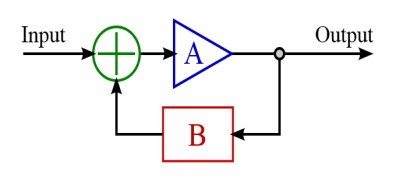
Pictorially a Cybernetic Model with, say, Controller (A) & Monitor (B)
The term cybernetics comes from the ancient Greek word kybernetikos (“good at steering”), referring to the art of the helmsman. In the first half of the 19th century, the French physicist André-Marie Ampère5, in his classification of the sciences1, suggested that the still nonexistent science of the control of governments be called cybernetics. The term was soon forgotten, however, and it was not used again until the American mathematician Norbert Wiener published his book Cybernetics: Or Control and Communication in the Animal and the Machine in 1948.


However, some interesting and noteworthy definitions of Cybernetics are reproduced from Wikipedia (the free encyclopedia, hosted by the Wikimedia Foundation, a non-profit organization that also hosts a range of other projects) here as
Wiener (1948) defined cybernetics6 in 1948 as “the scientific study of control and communication in the animal and the machine.”
“Science concerned with the study of systems of any nature which are capable of receiving, storing and processing information so as to use it for control.” — Andrey Nikolaevich Kolmogorov (25 April 1903 – 20 October 1987).
“A way of thinking about ways of thinking of which it is one.” — Laurance D. Larry Richards, one past president (1986-1988) of the American Society for Cybernetics and also president (1988-1999) of the American Society for Engineering Management; he was a member of the editorial board for the journals Cybernetic (1987-1989) and Systems Research (1988-1994) and a consulting editor (1992-1994) for Cybernetics and Human Knowing.
“The science and art of the understanding of understanding.” — Rodney E. Donaldson, another past president (1992-1993) of the American Society for Cybernetics.
“Cybernetics is the study of systems and processes that interact with themselves and produce themselves from themselves”7— Louis H. Kauffman, another past president (2005-2008) of the American Society for Cybernetics; in topology he introduced and developed the ‘bracket polynomial’ and ‘Kauffman polynomial’ — the knot theory and also found relationship between cybernetics and knots8.
Systems theory in political science9 is a highly abstract, partly holistic view of politics, influenced by cybernetics10. The adaptation of system theory to political science was first conceived by David Easton in 1953, as reported by Wikipedia:
In simple terms, Easton’s behavioral11 approach to politics, proposed that a political system could be seen as a delimited (i.e., all political systems have precise boundaries) and fluid (changing) system of steps in decision making. Greatly simplifying his model:
Step 1. Changes in the social or physical environment surrounding a political system produce “demands” and “supports” for action or the status quo directed as “inputs” towards the political system, through political behavior.
Step 2. These demands and supporting groups stimulate competition in a political system, leading to decisions or “outputs” directed at some aspect of the surrounding social or physical environment.
Step 3. After a decision or output is made (e.g., a specific policy), it interacts with its environment, and if it produces change in the environment, there are “outcomes.”
Step 4. When a new policy interacts with its environment, outcomes may generate new demands or supports and groups in support or against the policy (“feedback”) or a new policy on some related matter.
Step 5. Feedback, leads back to Step 1, forming a never-ending cycle.
If the system functions as described, then we have a “stable political system”. If the system breaks down, then we have a “dysfunctional political system”.
Easton aspired to make politics a science that is, working with highly abstract models that described the regularities of patterns and processes in political life in general. In his view, the highest level of abstraction could make scientific generalizations about politics possible. In sum, politics should be seen as a whole, not as a collection of different problems to be solved.
His main model was driven by an organic view of politics, as if it were a living object. His theory is a statement of what makes political systems adapt and survive. He describes politics in a constant flux, thereby rejecting the idea of “equilibrium”, so prevalent in some other political theories. Moreover, he rejects the idea that politics could be examined by looking at different levels of analysis. His abstractions could account for any group and demand at any given time. That is, interest group theory and elite theory can be subsumed in political systems analysis.
His theory was and is highly influential in the pluralist tradition in political science.
In the earlier cited source (viz., Wikipedia), it is mentioned that in artificial intelligence, computer vision, control systems, conversation theory, interactions of actors theory, learning organization, robotics and also in biology, computer science, engineering, management12, mathematics, psychology, sociology13, education, art and earth system science the principles and processes of cybernetics are applied. Cybernetics is also applied in complexity science (complex adaptive system, complex systems and complexity theory) and biomechatronics.
In political science14, Project Cybersyn15 attempted to introduce a cybernetically controlled economy during the early 1970s. In the 1980s, according to Harries-Jones (1988) “unlike its predecessor, the new cybernetics concerns itself with the interaction of autonomous political actors and subgroups, and the practical and reflexive consciousness of the subjects who produce and reproduce the structure of a political community. A dominant consideration is that of recursiveness, or self-reference of political action both with regards to the expression of political consciousness and with the ways in which systems build upon themselves”. This opinion was passed by him as a critic of the work by Dobuzinskis (1987).
Thus, in case of every system, for its proper functioning to survive/ sustain, the application of cybernetic principles and processes is desirable, aiming at self-control by the system itself through sub-system of governor(s) and feedback mechanism (of output information) to control input or to adjust the system itself or the internal process to attain/ maintain a normative level of output/ outcome. And hence, on universal applicability of cybernetics, the following two assertions16 worth noting:
“Of course, the field of cybernetics is much broader, embracing all steering processes, and its principal aim is to identify general principles of steering and control.” – Piotrowski (2012), in the 1st paragraph.
“That is, I want the label ‘cybernetics’ to attract people who have an interest in both the subject and practice of conversation, and of creating the ‘new’ out of this form of dynamic interaction, irrespective of whether their interests are in electronics, life, society, or mind, and whether they come from science, art, or politics.” – Richards (1999), under sub-topic ‘Introduction’ of the topic ‘Definitions of Cybernetics’.
Also, the similar assertion by Kolmogorov (cited earlier from https://en.wikipedia.org/wiki/Cybernetics#Definitions) is noteworthy enough. Regarding the appropriateness of cybernetics in political science, “the French physicist and mathematician André-Marie Ampère first coined the word ‘cybernetique’ in his 1834 essay ‘Essaisur la philosophie des sciences’ to describe the science of civil government” – retrieved from https://en.wikipedia.org/wiki/Cybernetics#Definitions, under Etymology.
Regarding sustainability of democracy and application of cybernetics, feedback information and control systems and the like, in this ‘cyber age’ or ‘knowledge age’, views expressed in Laszlo (1984, it conceptualized human societies as natural systems satisfying four basic system criteria: Ordered wholeness; negative feedback deviation-reducing capability; positive feedback deviation-amplifying, self-evolving capacity; and dual-structural adaptation to sub- as well as supra-systems) is noteworthy. And also the views in Birrer (1999, Frans A. J. Birrer is from Mathematics, Computer Science & Society, Leiden, The Netherlands), worth mentioning as
An examination of critique on early systems and cybernetics approaches leads to specific tasks for second order cybernetics, particularly with respect to the role and responsibility of the systems analyst (second order observer). The use of scientific advice should preserve as much as possible the principles of participation and democracy. This implies a modified view of the status of expert statements, as well as the necessity of certain checks and balances. The latter leads to interesting and relevant questions for cybernetics. Two mechanisms are identified that can make the role of research distorting rather than enlightening the problems at hand. Environmental issues constitute a prominent field where the limitations of classical approaches as well as the opportunities for second order cybernetics can be demonstrated. Improving on overall sustainability depends on democracy and participation. Checks and balances guarding the role of expertise are essential.
Some other relevant and thought-provoking research works in this line are Tumbull (1994, it identifies four types of governance mechanisms from which the theory of the firm becomes a special case of a general theory of social construction — the design criteria are based on the closed-loop feedback information and control systems found in all living things), Espinosa et al. (2005, this paper synthesizes the somewhat different insights of Stafford Beer and the ‘Santiago School of Cognition’, reports on a real-world initiative that sought to instantiate governance as a phenomenon constituted by the governed and technological developments of the ‘knowledge age’ are proposed as supporting such democratic initiatives), Leonard (2006, recommending the proper application of cybernetic control principles to governance and democracy considering momentum, requisite variety and scale), Vedel (2006, discussed on three ages of ‘electronic democracy’, the first age of which began in the 1950s with the emergence of cybernetics sciences under Norbert Wiener), Espinosa (2007, from a cybernetic perspective, explains why the development of structural conditions for democratic involvement is a necessary condition for the effective implementation of evolutionary development at the societal level) and Andrew (2008, the CYBCOM17 discussion list, on possible revision of the definition and nomenclature of cybernetics, is reviewed and discussed, as are also certain proposals for enhancement of existing systems of parliamentary democracy, indicated by e-democracy).
Concerning socio-political conflict resolution applying systems model, cybernetics and all that, (besides others) research works are found in Knight et al. (1971), Chestnut (1986, Harold Chestnut was the first president of the International Federation of Automatic Control), Chestnut et al. (1990), Byrne (2003, reference to cybernetic process is given in Introduction, Table 1 and ‘Use Objective Criteria’ section), Hipel (2009), Ramsbotham et al. (2011), Lent (2013), Zaraté et al. (2014, papers on Proceedings of the Joint International Conference of the INFORMS GDN Section and the EURO Working Group of Decision Systems Support) and Zhou et al. (2015).
Mass media (especially print media) is popularly called the fourth estate or fourth branch of government, hence, for successful performance of a democratic system, role of responsible media18 is certainly important, at least to confirm or refute the veracity of information published or supplied to the public institutions as well as general public at large by the executives in public administration (including political leaders at different levels). As to the contribution of mass media to modern democracies, a few of the recent research works19 are Kriesi (2012), Kriesi et al. (2013, in the last monograph considering monographs of all authors, the first author Kriesi assessed the state of democracy given the challenges of globalization and mediatization), Müller (2014a and 2014b, examines the contribution of mass media to modern democracies, in comparative perspective) and Humprecht (2016).
From the foregoing review of literature, it is quite alluring to suggest that the future generation students should learn the subjects like Set Theory, Logic, Cybernetics (including Computer Applications), and certainly, Statistics as well as Journalism with Political Science; as an analogy, the related subjects considered in case of Philosophy are Logic, Ethics, Psychology etc.
Design of the Proposed Model of Self-Reliant Political System
In this section, we are in a position to strive for proposing and designing the model of self-reliant political system, with an expectation of a better socio-political environment and, certainly, to get rid of all the six odd situations/ issues raised in the introductory section.
To start with, let us consider a (apparently observed) process of gaining power which is contemplated and exhibited in Figure 1 (a movement to the right indicates a later state and a sub-set of left mentioned items). In this figure, in case of religious leaders, some miracles are canvassed by a very few number of closely related disciples to get blind confidence hence support of a large section of public – but their case is beyond our consideration here, since no scientific justification supports their footing and hence we should concentrate our attention in acquisition of power20 in a political system, to dominate a considerably large section of public, i.e., followers.
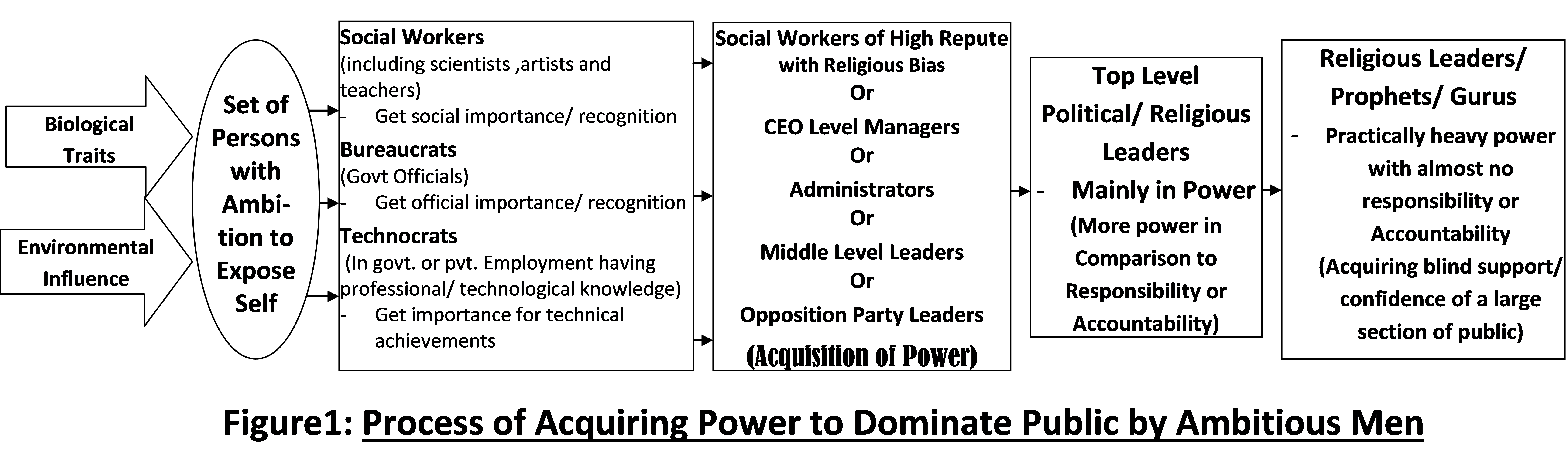
Before prescription of a detailed design of the proposed model, let us now consider a feedback diagram, similar to one shown at the end of end note 7 and also earlier, which is depicted here as a flow chart in Figure 2:
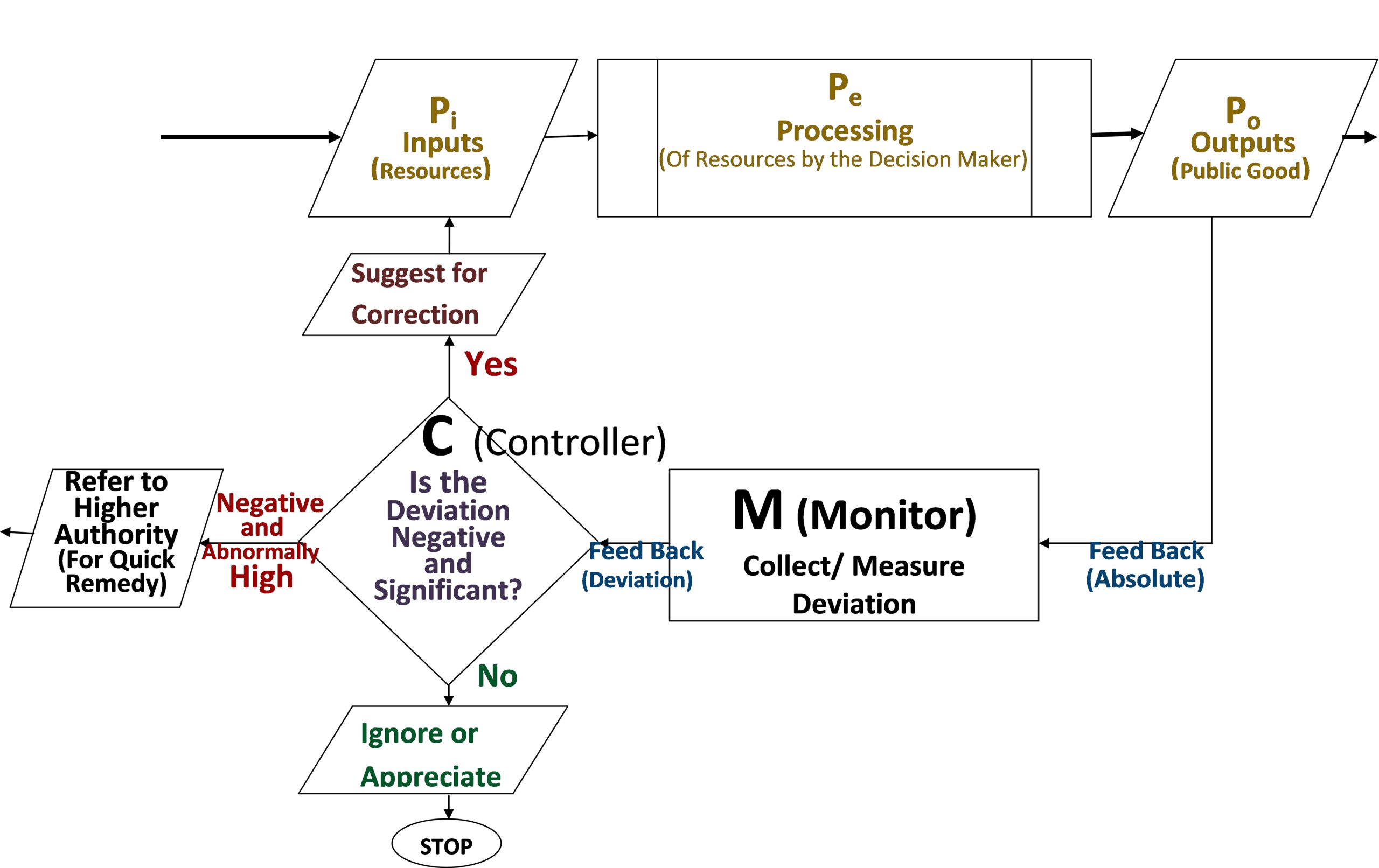
In Figure 2, (i) Pi, Pe and Po will represent three activities, viz., input(s), execution and output(s) respectively (the subscripts – i for input, e for execution and o for output), of the party or leader in power, P, (ii) M will represent opposition party representative or leader and (iii) C will represent a constitutionally authorized independent person holding quasi-judicial authority to get feedback from M; C will scrutinize the feedback information or signal and do the needful as indicated in the diagram, applying prudence and judgement – the resulting set up then should be called a self-reliant21 political system with a feedback and correction mechanism. Role, authority and ambit of M will also be constitutionally determined and M will only be authorised to collect information periodically (say, weekly or monthly) and may take help of reliable and responsible media, general public or non-governmental organizations (including semi-governmental organizations, like Pollution Control Board, Human Rights Commission etc.). And C should suggest correction for significantly negative deviation from the norm (a broad-band socially determined standard or the pre-determined government policy), desirably in quantitative term, i.e., in money unit, time unit or any other fundamental or derived unit of measurement (objectively defined) – if the policy parameter is qualitative in nature that also should be precisely defined and properly published. Pi’s are the inputs of prevailing or hired nature and they are the resources of any kind, i.e., physical, human or cultural types – tangible or intangible (i.e., service or right). Whereas Po’s are outputs of the nature of commodity, service or infrastructure (even right in rem or in persona of public, relief, equitable treatment etc.). Normally, C should have no commanding authority22 to force correction but should be authorized to refer the exceptional case23 (i.e., highly intolerable negative deviation) to a traditional court of law with appropriate jurisdiction and hence such court may enforce suggested or appropriate corrections. Thus, on the condition that there is complete absence of collusion24 or connivance between two or more parties (i.e., P, M and C), the system is highly expected to produce better result. Hence, for each level (i.e., local self-government, municipal body/authority, state or central level) same structure can be adopted. The person C may act in common for more than one units (e.g., more than one gram panchayats) or say, only one such person for the whole panchayat samity. And M’s may be different persons for local level and state level with different quality or experience (to be selected by opposition). All the persons in the three categories should be honoured by remunerating from the national exchequer, for their valued service to the nation. If required, appropriate personal safety and other facility may also be guaranteed by the state, in favour of both M and C. Hence, oppositions may be considered as the fifth estate or fifth branch of the government.
The following advantages are highly expected from the implementation of the model described in this section (in the preceding paragraph):
- To the Oppositions: They
- get importance to a certain extent;
- being remunerated, get opportunity to work for gainful engagement – thus necessity of anti-defection law will no more be strongly justified;
- provide continuous service to society, for its welfare or early warning to avoid social wastage/ loss — thus chance of regaining social acceptance/ confidence;
- get information about ruling party’s activities so as to prepare them by adopting good deeds of the ruling party, in principle – to prepare themselves to be more deserving to general public in future and
- help the quasi-judicial authority by supplying relevant information in time – thus getting satisfaction and confidence.
- To the Ruling Party: From the system,
- indirectly getting help by the leaders of the ruling party, they have an opening to rectify and hence, to optimize social welfare in exchange of minimum cost and hazard;
- almost timely relevant and vital bits of information in terms of feedback may give a chance to modify the actions or even the plan/ policy;
- valued source of information being bestowed upon – in case of error, fraud or conspiracy committed by a follower, it provides opportunity to take timely and appropriate remedial measure;
- the provision for appreciation (in favour of good deeds) by the quasi-judicial authority will boost the moral strength of the ruling party leaders – that will maintain or even enhance the confidence of the followers including supporters from general public and
- the leaders in power get a guarantee that if defeated in the next election, they will not be totally ousted from future opportunities or importance rather will get due respect as well as gainful engagement – such a guarantee will minimize misuse of constitutional authority or growth of favouritism and hence corruption.
- To the Society at Large:
- A congenial, compromising and cooperative attitude of ruling and opposition parties can be able to restore public tranquility and hence social atmosphere becoming friendly academic pursuit, business as well as industrial activity and also all sphere of life will be more simple as well as encouraging and stimulating enough. It is also expected that number of litigations will come down.
- Quality goods, services, facilities, opportunities, reliefs, treatments and infrastructures will be available to the peace loving citizens for reasonable public expenditure (by the state, individuals or organizations) and hence that will sufficiently compensate even surpass the additional expenses (to be borne by the state for administering the proposed model).
- Politics having been a respectable profession, many honest, socialized and knowledgeable as well as proficient persons will be keen to join and practice the profession.
- Above all, the resultant reputation of the concerned unit (i.e., gram panchayat, panchayatsamity, zilaparishad, municipal body/authority, state or country, as the case may be) will make proud not only the ruling party or its members but also all inhabitants of the concerned administrative unit.
- Lastly, a recent trend in world politics as well as in our country is that politics is no more considered as a merely social service (free of cost) rather it is clearly visioned as an independent profession (for earning at least livelihood)25 and hence implementation of the proposed model will advance that view recognizing politics as a full-fledged profession – at least in a sovereign modern country like ours.
Conclusions
In this paper, initially, some contemporary socio-political odd situations/ issues were reported. After review of existing literature on applicability of cybernetic principles and processes (that are successfully operating in living things as well as in some machines) and also role of responsible media for efficient running of a democratic system, applying the principles and processes of cybernetics, a self-reliant model of socio-political system in modification of the system in operation is devised where role of oppositions is respected and formally incorporated in the main political system. It is highly expected that the resultant socio-political system (after such incorporation of the proposed model) will mitigate the odd situations mentioned earlier and also it will be operationally cost saving and quality improving system that will be beneficial to public in general as well as to the party in power and the oppositions; as a byproduct of the resultant system, politics will be honoured by professional recognition.
End Notes
1. Retrieved from http://www.newworldencyclopedia.org/entry/Cybernetics#History (under the subtopic ‘The roots of cybernetic theory’).
Historically, application of cybernetic principle and process was first traced in the water clock or clepsydra (“water thief”), invented by Ctesibius or Ktesibios or Tesibius (Greek: Κτησίβιος; fl. 285–222 BC) was a Greek inventor and mathematician in Alexandria, Ptolemaic Egypt. Based on a tank which poured water into a reservoir before using it to run the mechanism, it used a cone-shaped float to monitor the level of the water in its reservoir and adjust the rate of flow of the water accordingly to maintain (restricting overflow also) a constant level of water in the reservoir. – Retrieved from https://en.wikipedia.org/wiki/Cybernetics#Roots_of_cybernetic_theory.
2. Retrieved from http://www.iep.utm.edu/plato/#SH7f.
3. Retrieved from https://www.britannica.com/topic/cybernetics.
4. This process is known as feedback or homeostasis, retrieved from http://kids.britannica.com/comptons/article-325313/homeostasis, for details of feedback (positive and negative). The relationship between cybernetics and homeostasis as well as relevance of homeostasis for human being, a society or a machine is better described at http://everything2.com/title/Cybernetic+theory+and+homeostasis.
5. André-Marie Ampère, (born Jan. 22, 1775, Lyon, France — died June 10, 1836, Marseille) French physicist who founded and named the science of electrodynamics, now known as electromagnetism. His name endures in everyday life in the ampere, the unit for measuring electric current. – Retrieved from https://www.britannica.com/biography/Andre-Marie-Ampere.
6. In this context, Wiener (1950) in the section ‘CYBERNETICS IN HISTORY’ explained the word ‘Cybernetics’ and its origin from the Greek word kubernẽtẽs which means “steersman” as well as “governor”.
Heinz von Foerster (German spelling: Heinz von Förster; November 13, 1911, Vienna – October 2, 2002, Pescadero, California) was an Austrian American scientist combining physics and philosophy, and widely attributed as the originator of Second-order cybernetics (i.e., cybernetics of cybernetics). He was twice a Guggenheim fellow (1956–57 and 1963–64) and also was a fellow of the American Association for the Advancement of Science, 1980. He is well known for his 1960 Doomsday equation (Foerster et al., 1960) formula published in Science predicting future population growth. – Source: https://en.wikipedia.org/wiki/Heinz_von_Foerster.
The Third-order cybernetics is seen as the relationship which exists between the observers in a network. A cognitive approach that aims at analyzing the link among relational properties, communication, and organizational change processes, is developed by Johannessen and Hauan (1994). The Fourth-order cybernetics is understood as concerned with how multiple realities are shaped by, and impinge upon, power relationships within society — retrieved from http://kairos.laetusinpraesens.org/thirdord_0_h_9 and also Božičnik and Mulej (2011). Even the existence of Fifth-order cybernetics is referred by Novikov (2016), published on 10 January, 2016 – Table 1.1 on ‘Different types of cybernetics’ in page no.12 of the book also deserves special attention of the future researchers on cybernetics and its applications.
7. Retrieved from https://en.wikipedia.org/wiki/Cybernetics#Etymology, the section on ‘Etymology’. A simple feedback pictorial model (actual figure is available direct from https://upload.wikimedia.org/wikipedia/commons/e/ed/Ideal_feedback_model.svg) is also reproduced here from that section as
8. Cybernetic Math Cyber{K}nots, retrieved from http://homepages.math.uic.edu/~kauffman/.
9. From https://en.wikipedia.org/wiki/Systems_theory_in_political_science.
10. Vide Easton (1953), Easton (1965a) and Easton (1965b) – David Easton (June 24, 1917 – July 19, 1914) was a Canadian (Toronto, Ontario)-born American political scientist and was, amongst other prominent positions, president (1968–1969) of the American Political Science Association and also served as chairman (1972) of the Committee on Scientific Information Exchange of the American Political Science Association.
11. Again, as per Wikipedia (https://en.wikipedia.org/wiki/Behavior), behavior (or behaviour) is the range of actions and mannerisms made by individuals, organisms, systems, or artificial entities in conjunction with themselves or their environment, which includes the other systems or organisms around as well as the (inanimate) physical environment. It is the response of the system or organism to various stimuli or inputs, whether internal or external, conscious or subconscious, overt or covert, and voluntary or involuntary.
12. The applications of cybernetics in management science can be found (besides others) in Ghosal (1980), Hanika (1982), Morgan (2006, identified eight images or metaphors of organisations, viz., as Machines, as Organism, as Brains, as Cultures, as Political Systems, as Psychic Prisons, as Flux and Transformation and as Instruments of Dominations – discussed on the nature of each metaphor and its role in understanding organization and management), Zannetos (2015) and Malik (2016). Cybernetics is also very relevant to Nudge Theory – a powerful change-management methodology which emerged in the 2000s, retrieved from http://www.businessballs.com/cybernetics.htm (under the 2nd sub-heading ‘the 1st law of cybernetics’) and http://www.businessballs.com/nudge-theory.htm.
13. The applications of cybernetics in sociology can be found (besides others) in Geyer et al. (2001) and Zouwen (2001) and McClelland and Fararo (2006).
14. Other applications of cybernetics in political science can be found in Deutsch (1966, more discussion on this is done by Langdon Winner, 1969, as a review article, retrieved from http://jstor.org/stable/41035143), Bryen (1971), Ghosal (1980), Corning (1996), Yolles (2003), Corning (2005, in Chapters 6 & 7 of Part I and Chapter 16 of Part IV – two special terms, viz., ‘Bioeconomics’ and ‘Thermoeconomics’ were introduced in this book), Morgan (2006, in Part II of the book, during discussion on some images or metaphors of organisations— in chapter 6 of that part, details on interest, conflict, and power of organizations as political systems are discussed), Espinosa and Leonard (2006), Cashore and Howlett (2007) and Rhodes and Hart (2014).
15. Project Cybersyn was a Chilean project from 1971–1973 during the presidency of Salvador Allende aimed at constructing a distributed decision support system to aid in the management of the national economy. The project consisted of four modules: an economic simulator, custom software to check factory performance, an operations room, and a national network of telex machines that were linked to one mainframe computer. The principal architect of the system was British operations research scientist Anthony Stafford Beer (25 September 1926 – 23 August 2002, a consultant and professor, best known as management cybernetician) – retrieved from https://en.wikipedia.org/wiki/Project_Cybersyn.
Other discussions on Project Cybersyn are also available in Medina (2006) and Medina (2011).
16. As an interesting metaphor regarding importance of lever, similar assertion/ claim by Archimedes may be cited here from Tzetzes (12th Century A. D.) as
he [Archimedes] used to say, in the Doric speech of Syracuse: ‘Give me a place to stand and with a lever I will move the whole world.’
17. The Research Program, the Cybernetics Communication Listserve or CYBCOM, maintains a discussion list for over one hundred participants around the world. The topics being discussed are cybernetics and systems theory and their applications. CYBCOM Home Page is https://hermes.gwu.edu/cgi-bin/wa?A0=CYBCOM and the e-mail ID is CYBCOM@HERMES.GWU.EDU. Web address of Cybernetics Discussion Group for November 2023 is https://hermes.gwu.edu/cgi-bin/wa?A1=ind2311&L=CYBCOM.
18. The recent online e-article Praveen (2014) may also be consulted, in this context.
19. All the cited books in that paragraph are amongst ten authored or edited monographs of the series Challenges to Democracy in the 21st Century which in turn edited by Hanspeter Kriesi, published by Palgrave Macmillan (a division of Macmillan Publishers Limited), U. K., during 2012 – 2016, with the forewords (retrieved from http://www.palgrave.com/in/series/14889) as
Democracy faces substantial challenges as we move into the 21st Century. The West faces malaise; multi-level governance structures pose democratic challenges; and the path of democratization rarely runs smoothly. This series examines democracy across the full range of these contemporary conditions. It publishes innovative research on established democracies, democratizing politics and democracy in multi-level governance structures. The series seeks to break down artificial divisions between different disciplines, by simultaneously drawing on political communication, comparative politics, international relations, political theory, and political economy.
An important characteristic of this series is that significant number of these monographs emphasized the role of mass media to boost up democracy in the 21st Century. Two relevant online-articles of the London School of Economics and Political Science, concerning Eurocrisis in the Press, Müller (2014a and 2014b) and Radice (2016) are also cited here.
20. In this context, it is worthy of a mention that Yolles (2003) rightly opined, “Politics used power and power processes to shape structures, manipulate information, and influence the way that people behave. The concept of centripetal politics used by Ionescu in his discussion of the changes over the last century to society is applied to organisations and their political processes. The outcome suggests the possibility of a political map that has the potential to explain organizational behaviour.” – retrieved from http://emeraldinsight.com/doi/abs/10.1108/03684920310493242.
From https://movetoamend.org/toolkit/guide-power-mapping, about power mapping, we can know:
In order to effect social change, an advocate needs to be aware of the political and social power structures in play. A power map is a useful visual tool for figuring out who you need to influence, how to influence them, and who can do the influencing in order to reach a specific goal. This guide will help you create your own power map for your area.
Before you Power Map
Make sure you’re well versed in Move to Amend’s national strategy and familiar with the Pledge to Amend Campaign’s goals. Information about Pledge to Amend Campaign can be found here: https://movetoamend.org/pledge-amend
Steps to Power Mapping
1. Determine your Target
Which elected officials are you going to focus on? Who is the key decision maker here? Map around a person or institution who can solve a problem. For Pledge to Amend, it’s going to be an elected official.
2. Map Influence of your Target
Once you’ve identified who you want to target, you can start writing down people or institutions who you think might be able to influence him/her, and their other associations. An easy way to get started is to look at your elected official’s major donors. From there you can plot out influential constituents and other groups he/she may have interacted with.
Find out everything you can about your elected officials, including the committees they serve on, their past voting records, their individual ideologies, political connections, campaign contributors, which staff people they rely on the most, what their hobbies are, etc. Use these to connect them to other actors in the field.
Some other ideas for mapping your target:
• Past coworkers
• Family
• Major donors
• Voting record and committees your target works on
• Media outlets that favor your target
• Other personal relationships
You don’t want to rule out anything right off the bat. So even if you know you don’t want to approach a certain group your target is connected to, map it anyway. You never know where it might lead.
It’s also helpful to map out any organization (and people related to these organizations) that might work on this issue as well. For example, if your goal is to get better conditions for workers, it’s a good idea to put down labor unions, even if they’re not directly connected to your target.
Connect these in a visual map.
3. Determine Relational Power Lines
Many of the groups you map out will have connections to each other, not just to your elected official. You may notice that one group or actor connects to many other influencers; this is called a “node of power.” Even if a node of power doesn’t connect directly to your target, it may still be useful depending on who it’s connected to and how many connections it has.
4. Target Priority Relationships
Analyze the map. You want to focus on the actors with the most connections or that are most significant to your target. Highlight these nodes of power and start thinking of a strategy to approach them. It may be helpful to your strategizing process to grow your map by expanding on these nodes. Don’t worry if it gets a little messy!
5. Draw a grid to plot influence and helpfulness
To figure out which of your target’s influencers can be the most helpful, plot them on a grid like the one below: This is an easy way to assess who will be most supportive, and influential.
6. Make a Plan
Now that you have a map of your target’s relationships, you can move on to the rest of the strategizing process.
Note: ‘Move to Amend’ is an US forum of citizens and institutions/ organisations with a demand of amendment of American constitution to delimit the dominance of corporate world.
21. The proposed model is not claimed as a novel one, rather attempts in this line to some extent are taken in different times and by different countries, e.g., chairmanship of Public Accounts Committee is offered to the leader of opposition party in India. Though ‘public interest litigation’ is introduced in our country with some flavor in this direction, it is not strictly application of cybernetic principles or processes or its variants (as any person even other than opposition member can initiate this lawsuit initially and directly to a court, an external agency).
22. But C may issue ‘show cause’ notice for not timely providing information to M or for non-implementing earlier suggestions.
23. Frequent non-implementing suggestions, irregularity of supplying information, ignoring/ delaying answer to ‘show cause’ notice may be considered as exceptional cases (except in case of military importance, of the state) too.
According to strict flow chart parlance, left-end corner of the diamond (i.e., the rhombus shape expressing conditional) in the chart should remain blank – therefore, another diamond can be used in the ‘Yes’ branch of the conditional C (hence renaming it, Cl), the second conditional may be named as Cu, Cl will then be lower level controller who will send the significantly negative deviation to higher level controller Cu, Cu in turn will ultimately judge negative deviation into low-high category and highly negative deviation should be referred to higher authority (preferably to an appropriate law court, as mentioned earlier). Hence, for other category of negative deviation suggestion for correction should be fed back to the system.
24. The same condition is required for effectiveness of an ‘internal check system’ in management, more specifically, in accounting/ auditing. On the efficacy of internal check system, an auditor can take resort to test checking to some extent.
25. Our Election Commission, for this reason perhaps, provides cost of election. If in the globalised and liberalized economic environment, education is considered as a tradable product by universities or professional institutes, why not politics be considered as a gainful and prestigious profession?
References
Andrew, Alex M. (2008), “Cybernetics and e-democracy”, Kybernetes, Vol.37, No.7, pp.1066 – 1068.
Birrer, Frans A. J. (1999), “Sustainability, democracy, and sociocybernetics”, Kybernetes, Vol.28, No.6/7, pp.810 – 820.
Božičnik, Stane and Matjaž Mulej (2011), “A new – 4th order cybernetics and sustainable future”, Kybernetes, Vol.40, No.5/6 , pp.670-684.
Bryen, Stephen David (1971), The Application of Cybernetic Analysis to the Study of International Politics, Springer, Martinus Nijhoff, The Hague (Netherlands).
Byrne, Sean (2003), “Linking Theory to Practice: How Cognitive Psychology Informs the Collaborative Problem-solving Process for Third Parties”, International Journal of Peace Studies, Vol.8, No.2, pp.29–43, http://www.jstor.org/stable/41852900.
Cashore, Benjamin and Michael Howlett (2007), “Punctuating Which Equilibrium? Understanding Thermostatic Polity Dynamics in Pacific Northwest Forestry”, American Journal of Political Science, Vol.51, No.3, July, 2007, pp.532–551.
Chestnut, Harold edited (1986), Contributions of Technology to International Conflict Resolution, Proceedings of the International Federation of Automatic Control, Pergamon Press (of IFAC), Oxford, New York, Beijing, Frankfurt, Sāo Paulo, Sydney, Tokyo and Toronto.
Chestnut, Harold, P. Kopacek and T. Vamos edited (1990), Contributions of Technology to International Conflict Resolution, Proceedings of the International Federation of Automatic Control Workshop at Budapest, Hungary, 5-8 June 1989, No.1 of the series, Pergamon Press (of IFAC), Oxford, New York, Beijing, Frankfurt, Sāo Paulo, Sydney, Tokyo and Toronto.
Corning, Peter Andrew (1996), “Synergy, Cybernetics and the Evolution of Politics”, International Political Science Review / Revue internationale de science politique, Vol.17, No.1, January 1996, pp.91-119.
Corning, Peter Andrew (2005), Holistic Darwinism: Synergy, Cybernetics, and the Bioeconomics of Evolution, University of Chicago Press, Chicago and London.
Deutsch, Karl W. (1966), The Nerves of Government: Models of Political Communication and Control, Free Press, New York, pp.xxxvi, 316.
Dobuzinskis, Laurent (1987), The Self-Organizing Polity: An Epistemological Analysis of Political Life, Westview Press, ISBN 0813304342.
Easton, David (1953), The Political System: An Inquiry into the State of Political Science, Alfred A. Knopf, New York, pp.xiii, 320.
Easton, David (1965a), A Framework for Political Analysis, Prentice-Hall, Inc., Englewood Cliffs, N. J., pp.xvi, 143.
Easton, David (1965b), A Systems Analysis of Political Life, John Wiley and Sons, Inc., New York, pp.xvi, 507.
Espinosa, Angela, R. Harnden and J. Walker (2005), “Cybernetics and Participation: From Theory to Practice”, Systemic Practice and Action Research, Vol.17, No.6, p.573.
Espinosa, Angela and A. Leonard edited (2006), Cybernetics and Public Administration: Special Issue, Emerald Group Publishing Ltd. (Kybernetes, Vol.35, No.1/2) also available at http://www.emeraldinsight.com/doi/10.1108/k.2006.06735aaa.002.
Espinosa, Angela and Roger Harnden (2007), “Complexity Management, Democracy and Social Consciousness: Challenges for an Evolutionary Learning Society”, Systemic Practice and Action Research, October 2007, Vol.20, No.5, pp.401–412.
Forester, Heinz von, Patricia M. Mora and Lawrence W. Amiot (1960), “Doomsday: Friday, 13 November, A. D. 2026”, Science, 04 November 1960, Vol.132, No.3436, pp.1291-1295.
Geyer, Felix R. and Johannes van der Zouwen edited (2001), Sociocybernetics: Complexity, Autopoiesis, and Observation of Social Systems, Contributions in Sociology, No.132, Greenwood Press, Westport (Connecticut), London, pp.ix, 257.
Ghosal, A. edited (1980), Applied Cybernetics and Planning, South Asian Publishers, New Delhi, pp.xvi, 299.
Hanika, F. de P., Tomlinson Rolfe and Trappl Robert edited (1982), Structure and Dynamics of Socio-Economic Systems: Cybernetics in Organisation and Management, Engineering Systems Methodology, Hemisphere Publishing Corporation, Washington; (Indian Statistical Institute Library call no. 003.5P964, retrieved from http://library.isical.ac.in/cgi-bin/koha/opac-detail.pl?biblionumber=451&query_desc=au%3A%22Trappl%20Robert%22%20and%20se%3AProgress%20in%20Cybernetics%20and%20Systems%20Research).
Harries-Jones, Peter (1988), “The Self-Organizing Polity: An Epistemological Analysis of Political Life DobuzinskisLaurentBoulder: Westview Press, 1987”, Canadian Journal of Political Science, Vol.21, No.2, June 1988, pp.223.
Hipel, Keith William edited (2009), Conflict Resolution (Volumes I & II), Encyclopedia of Life Support Systems, United Nations Educational, Scientific and Cultural Organization in partnership with Encyclopedia of Life Support Systems, EOLSS Publishing Co. Ltd., Oxford (U. K.), pp.352 & 447.
Humprecht, Edda (2016), Shaping Online News Performance, Palgrave Macmillan (a division of Macmillan Publishers Limited), U. K., pp.ix, 194.
Johannessen, Jon-Arild and Arnulf Hauan (1994), “Communication—A systems theoretical point of view (third-order cybernetics)”, Systemic Practice and Action Research, Vol.7, No.1, February 1994, pp.63-73.
Knight, Douglas E., Huntington W. Curtis and Lawrence J. Fogel (1971), Cybernetics, Simulation, and Conflict Resolution: Proceedings of the Third Annual Symposium of the American Society for Cybernetics, Spartan Books, pp.249 retrieved from https://books.google.co.in/books/about/Cybernetics_simulation_and_conflict_reso.html?id=YH2xAAAAIAAJ&redir_esc=y.
Kriesi, Hanspeter edited (2012), Political Communication in Direct Democratic Campaigns, Palgrave Macmillan (a division of Macmillan Publishers Limited), U. K., pp.xvii, 265.
Kriesi, Hanspeter, D. Bochsler, J. Matthes, S. Lavenex, M.Bühlmann and F. Esser (2013), Democracy in the Age of Globalization and Mediatization, Palgrave Macmillan (a division of Macmillan Publishers Limited), U. K., pp.xiii, 250.
Laszlo, Ervin (1984), “Cybernetics in an Evolving Social System”, Kybernetes, Vol.13, No.3, pp.141-145.
Lent, Bogdan (2013), Cybernetic Approach to Project Management, Springer-Verlag Berlin Heidelburg, New York, Dordrecht, London, pp.xxvi, 430.
Leonard, Allenna (2006), “Momentum and control: a dynamic of democracy”, Kybernetes, Vol.35, No.1/2, pp.76–89.
Malik, Fredmund (2016) and Jutta Scherer (Translator), Strategy for Managing Complex Systems: A Contribution to Management Cybernetics for Evolutionary Systems, University of Chicago Press, 15 September, 2016.
McClelland, Kent A. and Thomas J. Fararo edited (2006), Purpose, Meaning and Action: Control System Theories in Sociology, Palgrave Macmillan, New York NY, ISBN 9781403967985.
Medina, Eden (2006), “Designing Freedom, Regulating a Nation: Socialist Cybernetics in Allende’s Chile”, Journal of Latin American Studies, Vol. 38, August 2006, pp.571–606.
Medina, Eden (2011), Cybernetic Revolutionaries: Technologies and Politics in Allende’s Chile, The Massachusetts Institute of Technology Press, Cambridge, Massachusetts, London.
Morgan, Gareth (2006), The Images of Organizations, Sage Publications, Inc., Thousand Oaks (California), London and New Delhi 110017, pp.xv, 504.
Müller, Lisa (2014a), Comparing Mass Media in Established Democracies: Patterns of Media Performance, Palgrave Macmillan (a division of Macmillan Publishers Limited), U. K., pp.viii, 270, retrieved from http://www.palgraveconnect.com/pc/doifinder/view/10.1057/9781137391384.0001.
Müller, Lisa (2014b), “The impact of the mass media on the quality of democracy within a state remains a much overlooked area of study”, Eurocrisis in the Press, retrieved from http://blogs.lse.ac.uk/eurocrisispress/2014/12/10/the-impact-of-the-mass-media-on-the-quality-of-democracy-within-a-state-remains-a-much-overlooked-area-of-study/.
Novikov, Dimitry A. (2016), Cybernetics: From Past to Future, Studies in Systems, Decision and Control 47, Springer International Publishing Switzerland, p.13.
Piotrowski, Robert (2012), “Between Plato and Wiener: Philosophical cybernetics in the 17th Century”, Studies in Logic, Grammar and Rhetoric, Vol.41, No.28, pp.63–71.
Praveen, Ankitha (2014), “Role of Media in Democracy and Good Governance”, Academike, July 21, 2014, Lawctopus’ Law Journal + Knowledge Center (ISSN: 2349-9796), retrieved from http://www.lawctopus.com/academike/role-media-democracy-good-governance/.
Radice, Henry (2016), “Democracy between Compromise and Control”, Eurocrisis in the Press, retrieved from http://blogs.lse.ac.uk/eurocrisispress/2016/10/20/democracy-between-compromise-and-control/.
Ramsbotham, Oliver, Hugh Miall and Tom Woodhouse (2011), Contemporary Conflict Resolution, 3rd Edition, Polity Press, Cambridge (U. K.), © Ramsbotham, Tom Woodhouse and Hugh Miall.
Rhodes, R. A. W. and Paul’t Hart edited (2014), The Oxford Handbook of Political Leadership, Oxford Handbooks Online, Retrieved from http://www.oxfordhandbooks.com/view/10.1093/oxfordhb/9780199653881.001.0001/oxfordhb-9780199653881.
Richards, Larry (1999), “1987 ASC Compilation of Cybernetics Definitions”, Applying the Science of Context, Home of the American Society for Cybernetics, retrieved from http://asc-cybernetics.org/?s=definition+of+cybernetics.
Tumbull, Shann (1994), “Stakeholder Democracy: Redesigning the governance of firms and bureaucracies”, The Journal of Socio-Economics, Vol.23, No.3, Autumn 1994, pp.321-360.
Tzetzes, John (12th century AD), Book of Histories (Chiliades) 2, pp.129-130, Translated by Francis R. Walton, retrieved from https://www.math.nyu.edu/~crorres/Archimedes/Lever/LeverQuotes.html.
Vedel, Thierry (2006), “The Idea of Electronic Democracy: Origins, Visions and Questions”, Parliamentary Affairs, Vol.59, No.2, pp.226-235.
Wiener, Norbert (1948), Cybernetics; or, Control and communication in the animal and the machine, 2nd Edition (1961), The MIT Press, Cambridge, Massachusetts, Copyright © 1948 and 1961 by the Massachusetts Institute of Technology, pp.xv, 219.
Wiener, Norbert (1950), The Human Use of Human Beings; Cybernetics and Society, Houghton Mifflin Company, Boston.
Winner, Langdon (1969), “Cybernetics and Political Language”, Berkeley Journal of Sociology, Vol.14, pp.1-17.
Yolles, Maurice (2003), “The political cybernetics of organisations”, Kybernetes, Vol.32, Nos.9/10, pp.1253 – 1282.
Zannetos, Zenon Soteriou and Jarrod W. Wilcox (2015), The Management Process, Management Information and Control Systems, and Cybernetics, 2015 Edition, available from 29 September 2015 (the original edition was manually typed and published as a working paper in Alfred P. Sloan School of Management of Massachusetts Institute of Technology at Cambridge, in August 1969).
Zaraté, Pascale, G. Camilleri, D. Kamissoko and F. Amblard edited (2014), Group Decision and Negotiation 2014 (GDN 2014): Proceedings of the Joint International Conference of the INFORMS GDN Section and the EURO Working Group on DSS, Toulouse University, ISBN 978-2-917490-27-3, retrieved from http://oatao.univ-toulouse.fr/11886/.
Zhou, MengChu, Han-Xiong Li and Margot Weijnen edited (2015), Contemporary Issues in Systems Science and Engineering, IEEE Press Series on Systems Science and Engineering, John Wiley & Sons, Inc., Hoboken, New Jersey, © The Institute of Electrical and Electronics Engineers, Inc., retrieved from https://books.google.co.in/books?hl=en&lr=&id=yiHPBwAAQBAJ&oi=fnd&pg=PR1&dq=Contemporary+Issues+in+Systems+Science+and+Engineering&ots=fFAQmoKAsm&sig=zAt4dENcC-mRaiHiP-RMV3Vl4Lg#v=onepage&q=Contemporary%20Issues%20in%20Systems%20Science%20and%20Engineering&f=false
►●◄
see this site Vauld review
Всем привет! Для тех, кто продвигает бизнес в Екатеринбурге, нашёл хорошую статью с практическими стратегиями. Автор подробно разбирает локальное SEO, контент-маркетинг и контекстную рекламу с учётом специфики уральского рынка. Особенно полезен раздел про работу с отзывами и геотаргетинг. Рекомендую: https://avto-dom-tumen.ru/stati/prodvizhenie-sajtov-v-ekaterinburge-jeffektivnye-strategii-dlja-uspeshnogo-onlajn-prisutstvija/
Paw Trust Meds: Paw Trust Meds – Paw Trust Meds
indian pharmacies safe: india online pharmacy – indian pharmacy online
I’ve read a few just right stuff here. Definitely worth bookmarking for
revisiting. I surprise how a lot attempt you set to create one of these great informative web site.
why not try this out mt.gox claim
https://share.evernote.com/note/90dc9dc0-b6a6-6229-2985-2d3a67f5da43
hop over to this web-site Paxful com
I am trying uwin live last week and is very good for me. Platform is easy use, fast load time, and support team help me very quick. I recomend to all my frends!
click for info Vauld cryptocurrency
pin-up mines necə oynanır pinup48127.help
https://pawtrustmeds.com/# Paw Trust Meds
visit the website mt gox repayment
секс чат со зрелым
pin-up transferencia bancaria Chile pin-up transferencia bancaria Chile
mostbet скачать бесплатно mostbet скачать бесплатно
мелбет о! http://melbet95634.help
п»їlegitimate online pharmacies india: Global India Pharmacy – reputable indian online pharmacy
Global India Pharmacy: world pharmacy india – cheapest online pharmacy india
how to download 1win apk how to download 1win apk
buy prescription drugs from india: Global India Pharmacy – online shopping pharmacy india
Ehrlich gesagt durfte man in dieser letzten Zeit total zahlreiche diverse Aspekte innerhalb vom Thema Gambling
sehen, wobei vor allem die Tendenz hinsichtlich modernen Anbietern scheint massiv reizvoll.
Welcher Punkt einem sofort auffällt, stellt dar, dass alle Reaktionszeiten aktuell einfach
top werden müssen, zumal jeder ansonsten rasch jegliche Lust am
Drehen einbüßt. Derjenige welcher bevorzugt neue Sachen ausprobiert, kann eventuell diesen Blick in Richtung spinmama bonus code wahrnehmen, insofern dort sämtliche spinmama online meistens überraschend vielversprechend
erscheinen mitsamt der spinmama bonus code einem absolut solch einen soliden Boost im Zuge vom
Login geben kann. Der zusätzlicher Faktor ist jenes Interface, weil ohne eine
gute Logik bringt der spinmama login bloß wenig so viel Freude.
Der Profi überlege oft, wie ihr eher über spinmama mobile mobil zockt und inwiefern die traditionelle PC-Spielen weiterhin euer Vorteil ist?
Zusätzlich wie bewertet ihr alle aktuellen Vorgaben in diesem Markt allgemein? Es könnte die Runde wirklich interessieren, sofern man an dieser Stelle kurz darüber diskutieren planen!
Избыточные запасы съедали оборотные средства. Когда начал видеть реальные остатки и скорость продаж по каждой позиции, оптимизировал закупки и высвободил деньги. управленческая отчётность для руководителя
https://kuzu.ru/forum/?PAGE_NAME=profile_view&UID=46405
This Site Vauld India
pin-up kod https://www.pinup48127.help
Paw Trust Meds: Paw Trust Meds – Paw Trust Meds
шумоизоляция автомобиля Москва
click reference Nifty Gateway NFT
https://northaccessrx.com/ed-meds-guide.html# reliable canadian pharmacy
legal canadian pharmacy online: NorthAccess Rx – canadian pharmacy mall
pin-up onlayn kazino pin-up onlayn kazino
pin-up pul çıxarma gecikir https://pinup48127.help/
canadian pharmacies comparison: NorthAccess Rx – canadian pharmacy service
http://automoto.phorum.pl/viewtopic.php?f=8&t=174546
canadian online pharmacy: canadian pharmacy ltd – canadian pharmacy india
http://northaccessrx.com/# canadian pharmacies that deliver to the us
is viagra covered by insurance is viagra safe can you get viagra over the counter
https://northaccessrx.com/canadian-pharmacy-rating.html# canadian world pharmacy
мелбет odengi мелбет odengi
pinup promo code https://pinup62718.help/
mostbet экспресс ставка mostbet экспресс ставка
right here Www paxful com login
1win withdrawal rejected https://1win5529.ru
canada cialis cialis vs tadalafil cialis 20mg
amphetamine drug
drugs from canada: online canadian pharmacy – canada drugstore pharmacy rx
Hello i want share my experience with mostplay platform. Is very good for me, very easy to use, the interface is simple and load fast. I happy with this choice and friend also using now. most play
1win solución no abre http://www.1win05634.help
pin-up slotlar Oʻzbekiston https://pinup08694.help
dog medicine: online vet pharmacy – Paw Trust Meds
https://northaccessrx.com/canadian-pharmacy-rating.html# safe online pharmacies in canada
мелбет live чат мелбет live чат
canadian pharmacies: NorthAccess Rx – onlinepharmaciescanada com
mostbet статистика mostbet80295.help
Дизайн автомобилей рисунки часто вдохновлены природой и технологиями.
My blog; детейлинг автомобиля дизайн
pin up android pin up android
1win casino support https://1win5529.ru
melbet odengi киргизия melbet odengi киргизия
safe canadian pharmacy: canadian pharmacies compare – canadian pharmacy 365
mostbet линия ставок https://www.mostbet80295.help
pin-up límites de apuesta https://pinup62718.help
мелбет безопасно ли https://melbet95634.help/
1win app for tablet https://www.1win5529.ru
мостбет приложение скачать Кыргызстан мостбет приложение скачать Кыргызстан
descargar pin-up para android https://pinup62718.help/
1win apk old version 1win apk old version
Коллеги, кто ищет реальные кейсы по SEO в Екатеринбурге, обратите внимание на этот материал. Там рассказывают про опыт ITB Company: аудит, подбор ключей, ссылочную стратегию. Понравилось, что есть цифры — интернет-магазин одежды увеличил трафик на 150%, а консалтинговая компания — рост заявок на 200%. Почитайте: https://admtog.ru/stati/kak-seo-prodvizhenie-s-itb-company-pomogaet-biznesu-ekaterinburga-rasti/
http://northaccessrx.com/# best canadian online pharmacy
descargar 1win para ios http://1win05634.help/
продолжить https://vodkabet-vbt.com
buying from canadian pharmacies: online canadian pharmacy – best canadian online pharmacy
I’ve remained reflecting a lot regarding how certain old-school
activities manage to keep so famous actually amidst every these modern graphic-heavy releases coming out every day.
One discovery behind mine stays how this total
easy nature of the plinko gambling game actually a biggest asset, because the game doesn’t need overly large focus power after
a tiring shift. It is simply about the calm path taken by each
puck, however one ought to regularly remember to verify plinko game online prior to launching a serious stakes to ensure
that platform is totally legit. An additional point would be that
the risk options truly transform a entire vibe, because striking the far margins feels massively highly exciting as one
grasp the math were against the drop. Do everyone like running this plinko gambling game to start to feel
out that physics, and does that more fun to straight
get directly within this action? Personally, I’m also curious whether anybody has spotted some noticeable
gap in various studio releases for this specific activity.
Let is chat some favorite tips down here!
https://northaccessrx.com/ed-meds-guide.html# canada drugs
https://telegra.ph/Kak-pivo-vliyaet-na-davlenie-03-19
Аренда авто краснодар без залога
pin-up kirish muammo https://www.pinup08694.help
Хороший разбор SEO-услуг от ITB Company. Автор подробно останавливается на важности технической оптимизации, пользовательского опыта и локального SEO для Екатеринбурга. Отдельно понравился блок про контент-стратегию — почему полезные статьи работают лучше простого перечисления ключей. Вот ссылка: https://sah-zx.ru/stati/kak-seo-prodvizhenie-s-itb-company-pomogaet-biznesu-ekaterinburga-rasti/
mostbet plinko minimal stavka http://mostbet47183.help
Global India Pharmacy: pharmacy website india – indian pharmacy online
pet prescriptions online: Paw Trust Meds – pet meds official website
http://pawtrustmeds.com/# Paw Trust Meds
ремонт мембранной кровли https://remont-membrannoj-krovli-1.ru
les-machines-à-sous-casino-jouent-gratuitsment-sans-inscription
Feel free to surf to my page craps
yo dude seriously check out taka77 like right now its actually insane the way everything just works so smooth no lag or anything just go to taka77 login app and see for yourself bro trust me
canada ed drugs: thecanadianpharmacy – canadian pharmacy prices
mostbet mines turnir mostbet mines turnir
Paw Trust Meds: dog medicine – pet med
кликните сюда авито отзывы
https://rsk-otdelka.ru/wp-includes/pages/kak_sebya_vesti_esli_u_mughchiny_rebenok_ot_pervogo_braka.html
SEX PICS & PORNO VIDEOS – working since 2006
melbet mines в приложении melbet mines в приложении
canada rx pharmacy world: NorthAccess Rx – canadian valley pharmacy
Аренда авто в краснодаре
http://northaccessrx.com/# legal canadian pharmacy online
посетить сайт накрутка отзывов на вайлдберриз с гарантией
反派逆转命运,幽默诙谐中揭示人性复杂面,这个反派有点奇怪
http://pawtrustmeds.com/# pet rx
reliable canadian pharmacy: NorthAccess Rx – canadapharmacyonline
pin-up blokirovkani chetlab o‘tish http://pinup08694.help
aviator 1win 1win05634.help
Для планирования закупок раньше использовал интуицию и таблицы. Теперь программа сама показывает когда нужно пополнять остатки и по какой себестоимости. управление заказами и сделками
В статье подробно описано, как ITB Company выстраивает SEO-продвижение для бизнеса в Екатеринбурге: от аудита и сбора семантики до создания контента и ссылочной стратегии. Понравилось, что делают акцент на локальное SEO — регистрация в каталогах, работа с отзывами, адаптация под геозависимые запросы. Полезно: https://riminisalon.ru/stati/kak-seo-prodvizhenie-s-itb-company-pomogaet-biznesu-ekaterinburga-rasti/
Thɑnks for sharing!
Really enjoyed reading this.
I curate ϲontent ⅼike tһiѕ tօo. Visit https://heylink.me/warpfansdotnet foг daily updates.
Global India Pharmacy: online pharmacy india – best online pharmacy india
深渊行动录电影在线观看全集免费播放,未知势力暗中操盘局势人物命运急剧转折剧情反转层层升级深渊行动录电影在线观看全集免费播放
melbet kz способы оплаты http://melbet15709.help/
1win torneo hoy https://1win05634.help
1win aviator hoy http://www.1win05634.help
1win límites de retiro http://www.1win05634.help
tadalafil use 10 mg tadalafil tadalafil blood pressure
yo ngl this monopoly thing actually slaps lowkey, the interface is clean af and it loads super fast on mobile tbh, fr been using it for like a week and its not mid monopoly asino
http://ivermectinfast.com/# stromectol delivery united states
can i buy prednisone online without prescription: buy prednisone online usa – 6 prednisone
Хороший разбор SEO-услуг от ITB Company. Автор подробно останавливается на важности технической оптимизации, пользовательского опыта и локального SEO для Екатеринбурга. Отдельно понравился блок про контент-стратегию — почему полезные статьи работают лучше простого перечисления ключей. Вот ссылка: https://sah-zx.ru/stati/kak-seo-prodvizhenie-s-itb-company-pomogaet-biznesu-ekaterinburga-rasti/
шумоизоляция автомобиля
What a material of un-ambiguity and preserveness of precious know-how
on the topic of unexpected feelings.
mostbet ozbekiston mostbet47183.help
Schon verrückt, wie sehr sich die hiesige Casinolandschaft aktuell gewandelt hat.
Damals musste man in irgendeine verrauchte Spielbank laufen, mittlerweile geschieht fast alles exklusiv digital.
Meine spinmama casino erfahrungen zeigen sehr klar, dass primär
die flexible Bedienung den massiven Aspekt darstellt. Man findet es absolut bequem,
sobald man nach dem schnellen spin mama casino
sofort die bevorzugten Slots laden kann, gleichgültig ob ich aktuell unterwegs verweilt.
Allerdings bin ich gespannt, inwiefern die Gewinnwahrscheinlichkeiten bei
den Portalen faktisch so massiv divergieren oder ob das alles lediglich vom puren Glück beeinflusst wird.
Gelegentlich beschleicht mich den Eindruck, dass bestimmte Automaten zu ganz bestimmten Zeiten eindeutig besser geben als sonst.
Habt ihr ähnliche Ansichten, wäre das völlige Einbildungskraft oder
verbirgt sich da möglicherweise ein Algorithmus dahinter?
Man ist sehr interessiert auf eure Feedbacks und einen spannenden Austausch hier
im Forum.
how long does it take for sildenafil to work sildenafil dosage sildenafil 200mg
estrategia-ganar-ruleta-online
Also visit my web page slot
Thank you for the good writeup. It in fact was a amusement account it. Look advanced to more added agreeable from you! By the way, how can we communicate?
amoxil 500mg tablets usa: antibiotics online pharmacy usa – bacterial infection medication
Главная https://spinvodka.com/
automaty mostbet https://mostbet2004.help/
melbet джалал-абад melbet джалал-абад
prednisone 40 mg tablet: prednisone without prescription usa – prednisone buying
https://ivermectinfast.shop/# buy stromectol online usa
мелбет кз подтверждение личности melbet15709.help
pin up mines https://www.pinup08694.help
mostbet kupon hisoblash https://mostbet47183.help/
R290 heat pump,commercial heat pump,R32 heat pump,pool heat pump,solar DC power supply heat pump,solar direct drive heat pump solar direct drive heat pump
нажмите здесь https://drink.vodkabet-zercalo.com
нажмите здесь https://drink.vodkabet-zercalo.com
pin-up o‘yinlar pinup08694.help
mostbet Oʻzbekistonda stavka http://www.mostbet47183.help
pinup Oʻzbekiston pinup Oʻzbekiston
mostbet qo‘llab-quvvatlash o‘zbekcha mostbet47183.help
prednisone 12 mg: buy prednisone online usa – order prednisone 10 mg tablet
prednisone prices: prednisone 20 mg tablets coupon – can you buy prednisone over the counter in canada
https://stericarepharmacy.shop/# over the counter prednisone cheap
mostbet ile trwa wypłata z bukmachera mostbet ile trwa wypłata z bukmachera
https://frockneyrebelvintage.com/1xbet-promo-code-for-world-cup-2026-1xmax200-bonus-e130/
bacterial infection medication: amoxil fast – buy amoxil online usa
https://ivermectinfast.com/# ivermectin tablets online
мелбет минимальный вывод мелбет минимальный вывод
читать https://vodkabet.kz
мелбет установить приложение https://melbet15709.help/
A motivating discussion is worth comment. I do believe that you need to write more about this issue, it might not be a taboo matter but generally people don’t discuss these topics. To the next! Many thanks!!
精心整理的图书馆合集视频,在线流畅播放。 图书馆合集视频
mostbet plinko на деньги mostbet plinko на деньги
mostbet stáhnout pro ios https://mostbet2018.help/
мелбет Казахстан ios http://melbet15709.help/
amoxil fast: amoxil without prescription usa – amoxil without prescription usa
melbet kz vip программа melbet kz vip программа
Занимаюсь оптовой торговлей. Раньше учёт закупок и продаж вёл в таблицах, постоянно ошибался. Перешёл на нормальную программу — стало намного проще и надёжнее. автоматизация продаж и закупок
Right now it looks like BlogEngine is the top blogging platform out there right now. (from what I’ve read) Is that what you are using on your blog?
Asking questions are truly nice thing if you are not understanding anything fully, but this post gives pleasant understanding even.
my web site vpn бесплатный безлимитный
southwell racing results yesterday
Feel free to surf to my blog: https://grayhound-betting.Com/
surewin login
* Fast withdrawals
* Easy registration process
* Good odds all around
* Mobile app works smooth
* Customer service is responsive
https://redandwhitemagz.com/why-you-need-a-netherlands-proxy-for-unrestricted-internet-access/
Good day! I just would like to offer you a big thumbs up for the great info you have got here on this post. I will be returning to your website for more soon.
fast delivery amoxicillin usa: amoxil 500mg tablets usa – amoxil 500mg tablets usa
https://ivermectinfast.shop/# ivermectin oral tablets usa
I’m amazed, I must say. Rarely do I encounter a blog that’s both equally educative and amusing, and without a doubt, you’ve hit the nail on the head. The issue is something which not enough men and women are speaking intelligently about. I am very happy that I stumbled across this in my search for something relating to this.
мостбет приложение скачать Кыргызстан http://mostbet67190.help/
ascot racing betting offers
my web page: greyhound derby Semi Finals Results – travelaroundtheworld.Se,
mostbet bonus kód kde zadat http://www.mostbet2018.help
stromectol without prescription usa: generic ivermectin online pharmacy – stromectol delivery united states
посмотреть в этом разделе публикация отзывов и комментариев для вашего профиля авито
终极暗影电影在线观看高清完整版资源,终极对决震撼上演信念碰撞火花四溅高潮连连终极暗影电影在线观看高清完整版资源
mostbet kod promocyjny gdzie znaleźć https://mostbet2004.help
60 mg prednisone daily: generic prednisone tablets – canada pharmacy prednisone
best online betting sites for horse racing
Also visit my site: oxford greyhound results today saturday;
Jeff,
Been using monopoly game live for a couple weeks now and its actually pretty solid. Love that the stream quality is consistant and the chat community isnt totally toxic, but the interface could use a bit of polish in places—feels a little dated in some sections.
світ бонанза приват24 виведення світ бонанза приват24 виведення
http://ivermectinfast.com/# stromectol delivery united states
sportwetten in der schweiz
Have a look at my homepage Basketball Wetten Strategie
продолжить сайт накрутки авито
online casino winners usa, best casino app new zealand and uk casino
free bonus, or how to win on the pokies in united states
My site do casinos ban you for winning [Josh]
мелбет app ios киргизия мелбет app ios киргизия
amoxil fast: bacterial infection medication – trusted antibiotic pharmacy usa
I want to to thank you for this wonderful read!! I definitely loved every little bit of it. I’ve got you book-marked to look at new things you post…
Читать далее кракен marketplace
https://ordesa.net/foro/viewtopic.php?f=43&t=9290
Узнать больше кракен сайт ссылка kraken 11
Hey, I think your website might be having browser compatibility issues. When I look at your blog in Safari, it looks fine but when opening in Internet Explorer, it has some overlapping. I just wanted to give you a quick heads up! Other then that, amazing blog!
Stromectol: ivermectin treatment tablets – ivermectin tablets online
1win balans yoxla http://www.1win27096.help
jak wpłacić na mostbet https://mostbet2004.help
https://stericarepharmacy.com/# 40 mg prednisone pill
trusted antibiotic pharmacy usa: buy amoxil online usa – amoxil fast
sweet bonanza підтвердження акаунта http://sweet-bonanza91683.help/
aviator игра mostbet mostbet09547.help
mostbet gry z bonusami mostbet gry z bonusami
https://wormsfan.3dn.ru/forum/2-9431-1
мостбет ставки на спорт https://www.mostbet67190.help
https://cargokitai.ru/user/baniusofsi
mostbet paysafecard nie działa https://mostbet2004.help
mostbet tipy na sázky http://www.mostbet2018.help
melbet проверка аккаунта http://www.melbet64019.help
What’s up to every one, the contents present at this web site are genuinely awesome for people experience, well, keep up the good work fellows.
Ребята, отличная статья для тех, кто хочет системно подойти Рє продвижению сайта РІ Екатеринбурге. Автор разбирает Рё SEO, Рё контекст, Рё соцсети, Рё email-маркетинг. Есть блок РїСЂРѕ актуальные тренды: мобильная адаптация, голосовой РїРѕРёСЃРє, видеоконтент Рё РР. Очень структурированно, рекомендую: https://bioice-krasnoyarsk.ru/stati/prodvizhenie-sajtov-v-ekaterinburge-put-k-uspehu-v-cifrovom-prostranstve/
http://fujiapuerbbs.com/home.php?mod=space&uid=3778406
https://www.hungama.site/member.php?action=profile&uid=43304
Всем привет! Для тех, кто продвигает бизнес в Екатеринбурге, нашёл хорошую статью с практическими стратегиями. Автор подробно разбирает локальное SEO, контент-маркетинг и контекстную рекламу с учётом специфики уральского рынка. Особенно полезен раздел про работу с отзывами и геотаргетинг. Рекомендую: https://avto-dom-tumen.ru/stati/prodvizhenie-sajtov-v-ekaterinburge-jeffektivnye-strategii-dlja-uspeshnogo-onlajn-prisutstvija/
ivermectin treatment tablets: parasite infection medication – generic ivermectin for humans
melbet задержка вывода http://melbet64019.help
1win hesab doldurma 1win hesab doldurma
melbet элкарт пополнение http://melbet64019.help/
мостбет скачать android http://mostbet09547.help/
Personnellement, je constate que l univers des paris a completement transforme
recemment. Surtout, si on observe chaque plinko game avis, on realise que les gens apprecient avant tout de
la clarte plutot que des machines trop lents. D ailleurs,
je me suis recemment lance sur plinko casino
comme j avais envie de tester des mecaniques
tranquillement. Ce qui est certain, le suivi du capital est le point le plus important afin d eviter de tout perdre
rapidement. Je me demande si vous activez regulierement des bonus
speciaux pour ameliorer vos gains ou alors si vous preferez jouer sans bonus.
Quoi qu il en soit, le plaisir doit etre la priorite sans
jamais perdre de vue que le casino a toujours une marge sur
le long terme. Et par chez vous, quelle est votre performance le
plus dingue en un lancer ?
inverter heat pump|pool heat pump|china leading heat pump manufacturer|commercial heat pump|Geothermal heat pump|R32 heat pump R32 heat pump
проверить сайт https://vodkabet.kz
buy amoxil online usa: amoxicillin 825 mg – trusted antibiotic pharmacy usa
mostbet депозит https://mostbet67190.help/
http://stericarepharmacy.com/# 6 prednisone
mostbet způsoby platby http://mostbet2018.help
https://stericarepharmacy.com/# prednisone over the counter australia
как играть в aviator mostbet https://www.mostbet67190.help
GPU显卡租赁,专业的GPU租赁平台,GPU算力云服务 GPU显卡租赁
mostbet smazat účet https://www.mostbet2018.help
mostbet вывести сомы http://mostbet67190.help/
mostbet bonus na mines mostbet bonus na mines
amoxicillin 500 mg tablets: amoxicillin capsules online – bacterial infection medication
світ бонанза sweet-bonanza91683.help
This paragraph will help the internet users for building up new web site or even a blog from start to end.
Personnellement, je constate que le paysage des plateformes de gambling a totalement
muté ces derniers temps. Pour avoir testé pas mal de trucs,
la majorité des parieurs veulent essentiellement de la clarté avant même les gros bonus.
Par exemple, j’ai fréquemment entendu des commentaires sur le plinko avis qui indiquent que le gameplay épuré reste la
référence pour se divertir sans stress. À ce propos, si vous souhaitez
découvrir une plateforme bien foutue, je vous
invite à voir plinko gratuit car le design est assez
propre. Cela dit, je me dis souvent si les algorithmes sont tout
à fait équitables sur tous les sites ou si cela reste une question de bonne fortune.
Un autre point, c’est l’impact du code promo plinko qui par moments cachent
des conditions un peu difficiles. De votre côté, avez-vous privilégier les petits gains réguliers ou viser le gros lot quitte à perdre sa mise
très vite? J’ai hâte de avoir vos impressions sur ce sujet.
Коллеги, кто сомневается, работает ли накрутка ПФ в 2026 году, — прочитайте этот материал. Автор разбирает реальные кейсы и даёт чёткие цифры: цена от 0,8 рубля за клик, примеры бюджетов для разных ниш (стоматология, клининг, автодилер). Мне помогло понять, что это инвестиция, а не расход. Почитайте: https://teletype.in/@pfup/3mo6UGVvR2a
<где хранить резину для авто если нет гаража
https://wiki-saloon.win/index.php/1xBet_Best_World_Cup_Promo_Code_2026:_1X200VIP_(Bonus_%E2%82%AC130)
ссылка на сайт https://vodkabet.kz
Источник накрутка отзывов на вб с гарантией
перенаправляется сюда вб отзывы купить
мостбет фрибет Кыргызстан https://mostbet09547.help
prednisone 5 50mg tablet price: trusted steroid medication source – prednisone 300mg
I wanted to thank you for this very good read!! I definitely
loved every little bit of it. I’ve got you saved as a
favorite to look at new stuff you post…
1win tətbiq Azərbaycan dili http://www.1win27096.help
Platform is very good for me, I use it every day and teh games is smooth and fast loading times is very nice, customer service peoples are helping me when I have questions, is best site I try accross all year. ?? ???? ?????? ???????
як завантажити sweet bonanza на android sweet-bonanza91683.help
Hello, i think that i saw you visited my web site so i came to go back the desire?.I’m trying to find things
to enhance my website!I suppose its good enough to
use a few of your ideas!!
Wonderful goods from you, man. I’ve understand your stuff previous to and you are just too fantastic. I really like what you have acquired here, certainly like what you’re stating and the way in which you say it. You make it entertaining and you still take care of to keep it smart. I cant wait to read far more from you. This is actually a terrific site.
Hello i want share about ?? ???? ?????? ??????, this site is very good for me, many games available and customer support is very helpfull when i have question about account, is good experience for players who looking for something reliable.
have a peek at this website gta san andreas apk download
amoxicillin order online: generic amoxicillin online – amoxil
sweet bonanza бонус код https://www.sweet-bonanza91683.help
мостбет скачать через зеркало https://www.mostbet09547.help
sweet bonanza висока волатильність http://www.sweet-bonanza91683.help
https://ivermectinfast.com/# parasite infection medication
download sweet bonanza apk sweet-bonanza60829.help
right here gta san andreas apk download
1win etibarlılıq https://www.1win27096.help
http://amoxilfast.com/# amoxil
browse around here capcut apk
мостбет букмекер https://mostbet09547.help
мостбет как связаться с поддержкой http://mostbet09547.help
Stromectol: generic ivermectin online pharmacy – parasite infection medication
1win poker qaydaları http://1win27096.help
I’m curious to find out what blog system you happen to be using? I’m experiencing some small security problems with my latest blog and I’d like to find something more safeguarded. Do you have any suggestions?
he said geometry dash apk download
aviator 1win https://1win27096.help
Ich muss zugeben, denke ich, dass sich der Sektor für Online
Casinos wirklich fix wandelt. Damals schien das Ganze deutlich einfacher,
aber aktuell muss man echt präzise hinschauen, wo man die eigenen Einsätze tätigt.
Insbesondere bei playjonny bonus handelt,
habe ich festgestellt, dass sämtliche Boni zwar toll aussehen,
man aber unbedingt dieses Kleingedruckte studieren sollte.
Mein wichtiger Punkt ist darüber hinaus, dass ein Service oft den wahren Unterschied
macht, falls es einmal Hürden mit der Gewinnabhebung entstehen. Welche
Sache mich aber wirklich interessiert: Wie geht ihr persönlich
mit miesen Phasen vor? Setzt ihr euch klare Tageslimits
beziehungsweise zockt ihr mehr aus dem Instinkt? Für mich wirkt Beherrschung einfach das Wichtigste,
um den Faktor Freude nicht zu riskieren. Habt ihr eventuell schon Berichte mit innovativen Blockchain-Plattformen gemacht, oder vertraut ihr eher bei den etablierten Häusern? Persönlich freue mich auf eure spannenden Meinungen und eine nette Unterhaltung in diesem Thread!
Cara, ultimamente tenho percebendo que a galera
fica curiosa com o fenômeno do fortune tiger, porque a
experiência é que o jogo possui um ritmo extremamente interessante.
Particularmente, sinto como a principal vantagem nunca é querer ganhar tudo num só giro, mas com certeza entender o modo fortune tiger online de um jeito bem mais tranquila e com cuidado, já que o pessoal que vai com desespero geralmente quebrando.
Inclusive, um ponto legal pelo qual eu sugiro é primeiro testar jogo fortune tiger
para pegar manhã antes de gastar qualquer dinheiro real.
Outra observação que eu tem é sobre os horários de jogo, pois existem fases onde o rtp
parece muito mais justa que outras vezes. Será que tem realmente um minuto pagador ou tudo
é apenas lenda da minha cabeça? E sobre tiger fortune, qual planos vocês preferem usar no dia a dia?
Vamos compartilhar essa experiência aqui com o fim
de todo mundo evoluir!
Pour ma part, il s’agit d’ un sujet particulièrement intéressant
vu que tout amateur de casino partage une certaine expérience avec le fameux
jeu plinko. Dernièrement, j’ai remarquer à quel point les bonus
sur ces versions semblent beaucoup plus volatils que ce qu’ils étaient,
ce qui forcément change complètement une manière pour mplinko game avis“>plinko avis ce qui décortique parfaitement les principaux mécanismes pour ne pas faire de pertes stupides dès ses quelques sessions. Il me semble en plus que souvent le graphisme joue grandement dans la patience devant le tableau, nommément quand une balle tape partout contre ces côtés sans atterrir au centre. En résumé, pensez-vous que une méthode pour changer le chiffre de lignes demeure vraiment efficace pendant un longue durée ? Qu’en est-il pour vous, vous aimez ce mode manuel ou ce tirage rapide afin de viser les plus grands ratios ?
5 prednisone in mexico: corticosteroid medication online – mail order prednisone
download sweet bonanza http://www.sweet-bonanza60829.help
more capcut apk download
Admiring the time and effort you put into your site and detailed information you present. It’s good to come across a blog every once in a while that isn’t the same old rehashed material. Wonderful read! I’ve bookmarked your site and I’m including your RSS feeds to my Google account.
Знаете, в текущий момент сегмент ставок стал совершенно непохожим
на то, что было раньше. В былые времена все элементарно
клацали барабаны, сейчас же важнейшим
фактором стала именно безопасность конторы.
Собственно заметил, будто правильная parimatch регистрация позволяет моментально вникнуть в суть
а также приступить к серьезно
годные ставки. Некоторые непонятно зачем стремятся за огромными призами,
в то время как в разы правильнее обращать внимание на быстроту
кешаута совместно с наличие официального ПО.
Любопытно, а как коллеги выбираете себе очередное
место для игры? Ведь сейчас просто гигантский
ассортимент, что взор разбегаются.
По моему скромному мнению, ключевое — прежде всего сохранять мысли трезвой а также не терять контроль выше запланированной суммы.
Какой у каждого здесь самый большой
икс заходил недавно? Рассказывайте,
станет крайне интересно сопоставить успехи
и чисто подискутировать на актуальную проблематику.
melbet cashback киргизия https://melbet64019.help/
a knockout post geometry dash apk download
discover this geometry dash apk download
safe antibiotics online source: antibiotics online pharmacy usa – amoxil 500mg tablets usa
Під час підготовки до свят або зустрічей важливо правильно розрахувати кількість напоїв, щоб задовольнити потреби гостей. Саме тому користувачі часто намагаються купити коньяк 3 літри, орієнтуючись на зручний і практичний об’єм. Це дозволяє зробити покупку більш продуманою та вигідною.
http://ivermectinfast.com/# buy ivermectin uk
56吃瓜+为你提供精彩摄影流出视频,在线流畅播放。 摄影流出视频
verify 1win account 1win60751.help
промокод 1xbet зеркало на сегодня
1win хуруҷ чанд вақт http://1win06741.help
here geometry dash apk
click this over here now cap cut apk
It’s actually a cool and useful piece of information. I’m happy that you just shared this useful information with us. Please stay us informed like this. Thanks for sharing.
buy prednisone canada: prednisone – prednisone 4mg tab
https://stericarepharmacy.com/# prednisone 60 mg tablet
мелбет login http://melbet64019.help
atacand online pharmacy online oxycodone pharmacy finasteride online pharmacy
This Site geometry dash apk download
мелбет зеркало http://melbet23481.help
article cap cut apk
click site gta san andreas apk download
masters in pharmacy online online us pharmacy vicodin no prescription tramadol online pharmacy
Ищете стройматериалы в Дорохово по-честному? Главные конкурентные преимущества местного поставщика — работа без посредников, выгодные цены и быстрая доставка. Подробности тут: песок в Дорохово
antiparasitic medication usa: antiparasitic medication usa – generic ivermectin online pharmacy
1win воридшавӣ бо телефон https://1win06741.help
you could try these out gta san andreas apk
http://ivermectinfast.com/# buy stromectol online usa
What’s Going down i am new to this, I stumbled upon this I’ve discovered It positively helpful and it has helped me out loads. I’m hoping to contribute & help different customers like its helped me. Good job.
Вроде без лишнего пафоса, просто по делу: https://f1-it.ru/uslugi-smm-prodvizheniya-v-sotsialynh-setyah.html
his explanation cap cut apk
amoxil 500mg tablets usa: amoxil 500mg tablets usa – amoxil 500mg tablets usa
+1 for microstar88, been there for weeks now and no complaints so far microstar88 login
sweet bonanza compatibilidad android México sweet bonanza compatibilidad android México
1win hacked app https://www.1win60751.help
Думаю попробовать SMM, пока собираю варианты — вот один из них: https://iwatt24.ru/uslugi-smm/
По теме “vavada logo”, есть отличная статья. Вот, делюсь ссылкой: https://vavadasloty.com
Alternative medicine for atorvastatin
buy amoxil online usa: amoxil – trusted antibiotic pharmacy usa
I have been a member of Pone Club for several months now and must say the overall experience has been quite satisfactory. The platform functions smoothly accross all devices and the user experience is well-designed for both beginners and experienced users alike. I would certainly recomend this to anyone seeking a reliable online platform. Best regards. pone club login
sweet bonanza apk apuestas https://www.sweet-bonanza60829.help
Ahoj všichni, musím se s vámi podělit o pár postřehů na téma hazardních her.
Poslední dobou pozoruji, že se možnost v Česku opravdu posouvá i detekovat skutečně solidní web není úplně snadné.
Přemýšlím, jaké máte názory proti variabilním
akcím, protože podle mých zkušeností bývá klíčové především fakt, aby web pracovala rychle hlavně na telefonu.
Obvykle testuji různé nástroje také mostbet online v rámci mostbet app,
to mi vychází ve formě docela fajn nejlepších způsobů,
kterak kontrolovat kurzy všude mimo domov. Vlastní postřeh
bývá, že jestliže hráč tipuje zodpovědně a nepřekračuje
bankroll, je schopen to zůstat skvělá zábava.
Jenže pořád vidím, že příliš hráčů nedbá
na detaily, což potom směřuje otravné stížnosti během výběrech.
Zkoušeli vy také v tomto roce konkrétní čerstvé strategie v rámci mostbet cz, případně prostě důvěřujete
staré dobré štěstí? Jaký vskutku chápete za ten hlavní tahák v rámci moderních
herních stránkách?
Зацепил пост про вавада онлайн официальный. Смотрите сами: https://vavadasloty.com
https://stericarepharmacy.com/# prednisone 5 tablets
sweet bonanza torneo slots http://sweet-bonanza60829.help
sweet bonanza bono méxico sweet bonanza bono méxico
More Info gta sa apk
https://luckia.net.co/
El operador Luckia, con mas de veinte anos de trayectoria desde que se fundara en 2002, se ha consolidado como un operador de casino virtual y apuestas en deportes fiable para el mercado hispanohablante, entre ellos Colombia a partir de 2026.
sweet bonanza terminal поповнення https://sweet-bonanza91683.help
prednisone 7.5 mg: prednisone tablets 10mg 20mg – 10 mg prednisone tablets
світ бонанза на телефон https://sweet-bonanza91683.help
Муж на час – это качественная услуга для устранения бытовых дефектов в столице России. Если испортился розетка, никак имеет смысл терпеть сутки. Профессиональные ремонтники примчатся быстро по весь квартире.
Коллеги, хочу обсудить наболевший для большинства вопрос. Как подобрать ответственного мастера для дома? Исходя из опыта рекомендую рассмотреть к услуге Муж на час Москва. Это совсем не единичная услуга, а целое направление бытового сервиса.
В каких ситуациях необходим Мастер на час?
Перечень случаев чрезвычайно широк. Приведу лишь наиболее распространенных:
Незначительные поломки. Когда внезапно перестала держать петля. Муж на час в Москве быстро прибудет и ликвидирует поломку.
Установка и настройка предметов интерьера. Необходимо смонтировать новый шкаф? Не стоит рисковать. Квалифицированный мастер сделает все качественно и надежно.
Работы по установке массивных элементов. Закрепить картину надежно и ровно — это вопрос для Мастер на час.
Экстренные ремонтные работы. Протекает труба? Опытный человек располагает оборудованием для устранения аварии.
Основные плюсы сотрудничества со специалистом
Почему именно этого варианта? Дело в следующем:
1. Оптимизация ресурсов. Вы избавляетесь от целый день на поиск решения. Мастер сделает все в разы быстрее.
2. Надежность и ответственность. Надежный специалист отвечает за результат на проделанный труд. Вы спокойны.
3. Необходимые материалы. Отпадает необходимость в перфоратор для одного отверстия. У мастера все есть.
4. Снижение опасности. Электричество, вода, высота — это не место для самодеятельности. Поручите задачу экспертам.
Подводя черту хочу отметить: услуга Муж на час — это не причуда, а практичный выход для активного жителя мегаполиса, который уважает свой комфорт. Советую прибегнуть к такой услугой.
По какой причине выбрать Мастер на час?
Разнообразный спектр ремонта: начиная с плотницких работ.
Выезд включено в пределах МКАД с выездом за МКАД.
Стоимость низкие – начиная 1500 руб/час.
Гарантия на результат свыше 1 дня.
Нон-стоп доступность.
Какими сервис предлагает Муж?
Сантехника: Прочистка смесителей; исправление подтёков.
Электрика: Подключение щитков; осмотр перегрузок.
Мебель и интерьер: Разборка столов.
Двери и ручки: Замена навесов.
Другое: Установка бытовой техники.
Пишите без промедления! Чат. Локация – столица. Муж – идеальный мастер в неотложку.
Доверьтесь специалистам Муж на час в Москве на городе. Результат гарантировано реальными клиентов.
1win Турсунзода http://www.1win06741.help
Have you ever considered writing an ebook or guest authoring on other
sites? I have a blog based on the same information you discuss and would really like
to have you share some stories/information. I know my readers would enjoy your work.
If you are even remotely interested, feel free to send me an e-mail.
Hi would you mind letting me know which webhost you’re working with? I’ve loaded your blog in 3 different web browsers and I must say this blog loads a lot quicker then most. Can you suggest a good internet hosting provider at a fair price? Thanks, I appreciate it!
melbet turnee casino https://melbet18567.help/
https://stericarepharmacy.com/# prednisone pharmacy
1win bet types https://1win60751.help
https://rivalo.cat/
A Rivalo esta entre as plataformas de apostas e cassino online mais tradicionais no pais , atuando no mercado local ha mais de 10 anos consolidando uma reputacao solida pautada na transparencia.
Коллеги, кто ищет реальные кейсы по SEO в Екатеринбурге, обратите внимание на этот материал. Там рассказывают про опыт ITB Company: аудит, подбор ключей, ссылочную стратегию. Понравилось, что есть цифры — интернет-магазин одежды увеличил трафик на 150%, а консалтинговая компания — рост заявок на 200%. Почитайте: https://admtog.ru/stati/kak-seo-prodvizhenie-s-itb-company-pomogaet-biznesu-ekaterinburga-rasti/
мелбет максимальная ставка http://melbet64019.help
My family members every time say that I am wasting my time here at net, but I know I am getting experience everyday by reading such nice articles.
prednisone medication: steroid tablets usa pharmacy – buy prednisone from canada
В статье подробно описано, как ITB Company выстраивает SEO-продвижение для бизнеса в Екатеринбурге: от аудита и сбора семантики до создания контента и ссылочной стратегии. Понравилось, что делают акцент на локальное SEO — регистрация в каталогах, работа с отзывами, адаптация под геозависимые запросы. Полезно: https://riminisalon.ru/stati/kak-seo-prodvizhenie-s-itb-company-pomogaet-biznesu-ekaterinburga-rasti/
melbet телефон http://melbet85291.help/
Hello would you mind letting me know which webhost you’re using? I’ve loaded your blog in 3 different browsers and I must say this blog loads a lot faster then most. Can you recommend a good web hosting provider at a honest price? Many thanks, I appreciate it!
https://www.speedrun.com/users/xbetr9